Chances are you'll recognize this.
At some point, you chose a civil (also known as registrered) partnership. Not because your love was any less, but because it made sense at the time. Practical, straightforward, well organized.
And now you’re in a different season.
You want to get married. With confetti, with tears, with a ceremony that feels like a true milestone.
Then, out of nowhere, that one sentence shows up. During an intake meeting, at the city hall counter, or only when you start thinking about moving abroad.
“This won’t be a marriage. This will be a conversion.”
Small word, big impact.
In this blog post, I’ll explain what a civil partnership means legally, how it differs from marriage, and what that could mean for your ceremony, especially if there’s even the slightest international element in your future.
What is a civil partnership?
A civil partnership is an official form of relationship in the Netherlands. Like a marriage, it’s formally recognized by the government.
But it’s subtly different.
Put simply.
A marriage is created through spoken words.
A civil or registered partnership is established through a legal document.
That may sound like a small detail, but on a day that’s all about meaning, it can suddenly feel very real.
Civil partnership vs. marriage: what's the difference?
In everyday life, the two are quite similar. You can establish rights and obligations, acknowledge children, and take out a mortgage together.
And yet there is a difference. Not just in the label, but in where the legal focus lies.
With a marriage, there’s a distinct moment: words are spoken, and then the documents are signed.
With a civil partnership, the emphasis is on what’s put in writing. The deed is the defining moment.
For many couples, that difference doesn’t matter for years. Until you want to celebrate, or until you start looking beyond your own borders.
What does this mean for your ceremony?
This is usually the moment where I pause during our first consultation. Not to take the magic out of it, but to make sure everything feels smooth and aligned on your day.
With a marriage, there’s traditionally a clear “threshold moment” in the ceremony. The words are spoken, there’s a build-up, and it can genuinely feel like you cross into a new chapter together, also in a legal sense.
With a civil partnership, the legal rhythm is different.
And that doesn’t make it any less beautiful. It just means we choose our words with care, so what’s being said matches what’s actually happening.
Instead of a formal “I now declare…” phrase, I’ll often use wording that reflects the legal reality, for example:
“From this moment on, you are legally registered partners.”
Or:
“With your signatures, your civil partnership is now official.”
It may sound like a small detail, but it prevents legal inaccuracies in the ceremony, and that peace of mind helps everyone relax into the moment.
From a civil partnership to marriage
If you are already in a registered partnership, you can convert it into a marriage in the Netherlands. For many couples, this is a wonderful next step.
At the same time, it helps to know this. A conversion is not the same as “getting married” in the classic legal sense.
Of course, emotionally it can still feel exactly like that. Like you’re choosing each other again, and turning it into a true milestone. And that’s completely valid. During the ceremony, you can absolutely say “I do,” exchange vows, and include rituals that make it yours.
What is important, though.
In a conversion, the legal part happens at the moment you sign the marriage certificate. So if you want the words, vows, and any “official” phrasing to match the legal reality, we simply structure the ceremony so the affirmation and congratulations come after the signing.
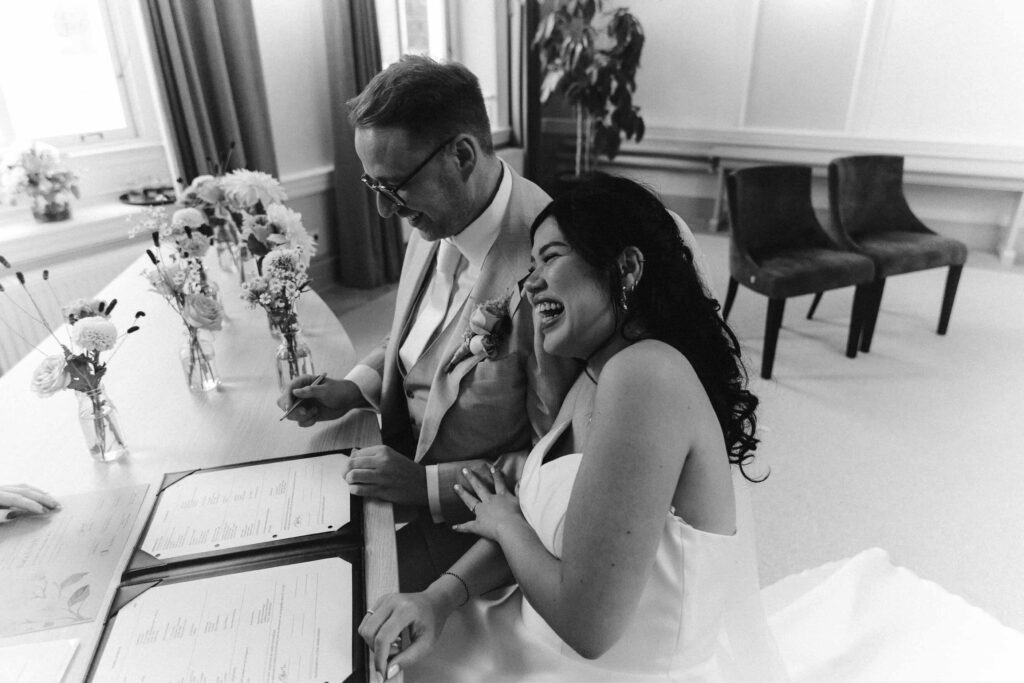
ELIZADM Photography
This is the part many people don’t realize until it’s too late.
This is the part that many people don't realize until it's too late.
A Dutch marriage is recognized in many countries. A Dutch registered partnership is not always recognized.
Furthermore, a marriage that resulted from the conversion of a civil partnership is not automatically recognized as a “marriage” in the same way in every country.
This becomes especially relevant if your plans reach beyond the Netherlands, for example if you: want to emigrate or live abroad for a longer period, have different nationalities involved, need residency rights or immigration paperwork or rely on international documents (think: visas, name changes, family reunification).
I’m not a lawyer, but I do feel it’s responsible to flag this early. That way, you don’t discover after your ceremony that there’s an extra administrative step, or that a document won’t be accepted the way you expected.
If you’re unsure, check with your municipality and, if needed, speak to an immigration lawyer or family law specialist.
In some situations, it can be wiser to formally dissolve the registered partnership first and then marry. It’s more effort, yes, but it can also create clarity internationally.
One last, loving reminder
No matter which option you choose, a civil partnership or a marriage.
It comes down to the same thing.
That you choose each other.
And that you turn it into a moment that matters. A milestone. Something you’ll think back on later, on an ordinary Tuesday, and feel it again.
Yes.
This was ours.
Would you like to talk through what fits your situation best, and how we can shape a ceremony that’s warm, personal, and legally sound?